Another silly patent that the American patent system can be criticized for is a Foot pump powered neck massaging device. So, as you walk, your neck gets squeezed every time you take a step. It includes multiple bladders secured to the lower surface of a shoe worn by the user. The first bladder and the second bladder each have an air outlet. A massaging hand is attached to this. It also consists of pliable fingers. The fingers are conformable around the user's neck.
This is an extremely absurd patent, and is not useful at all.
Saturday, May 11, 2013
Friday, May 10, 2013
Week 14, Post 1 — It slices! It dices! It collects evidence!
US Patent No. 7131444 is about an Internal Implement Allotropy Sexual Aid Utensil Universal-Disk. This awkwardly titled patent sets "a new standard for internal personal prevention worn in the female vagina." It is an anti-rape device which is quite admirable in its thoroughness:
This invention is inserted into the vagina of a female wearing it in the same way as a tampon length wise and pushing it into the vaginal cavity. Upon placement in the vagina, the invention blocks the entrance to the vagina, and exposes a resilient hollow receptacle tip covering a sharp circular projectile disk with a dimensional center hole covering the specimen cavity. The sharp projectiles will inflict a sharp non-lethal pain to head of the penis attempting to penetrate the vagina, and the dimensional center hole is designed to collect specimens when the head of the penis makes contact with the sharp circular projectile disk.
This is definitely not a useful invention in terms of practicality. The inventor himself acknowledges about this impracticality. However his defense is that, "Men considering rape, after this invention becomes known, will hopefully not attempt it, with the dread that any women [sic] could be wearing this. Just the idea of it is enough—it doesn't even need to become a product to be effective. So help me spread the word!"
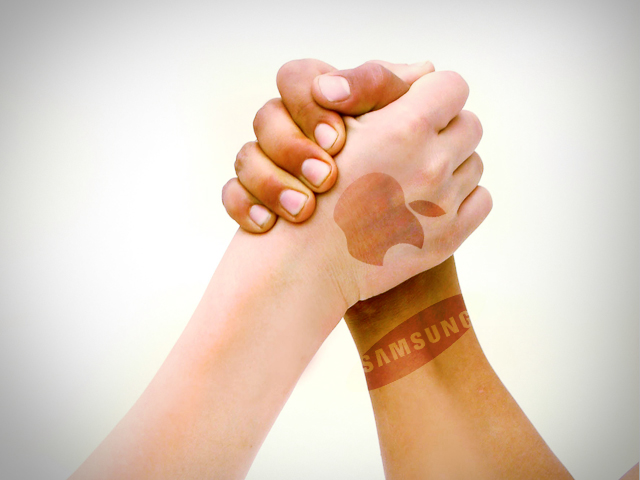
Week 13, Post 2 — Apple and Samsung relations set to improve
As I come towards the end of a very interesting semester, where the majority of articles I've read have been about Apple and Samsung's rocky relationship, with each company suing the other at every opportunity, I want to discuss the possibility of their relationship improving.
Apple's current CEO, Tim Cook has a very different view from Apple's ex-CEO Steve Jobs, who in the past announced thermonuclear war against Google's Android. Cook reportedly never wanted to sue Samsung in the first place over various patents and copyright infringement. He said that he isn't interested in suing Samsung, as the South Korean giant is one of the key component suppliers for the iPhone and iPad.
For Samsung, Apple is being regarded as more than a client. As we all know, the most valuable tech company holds many important patents especially for smartphones and tablets with touch based features.
For future releases such as Samsung Galaxy S4 and the next iPhone, relationship is key.
Only time will tell, whether this relationship will improve or not.
Week 13, Post 1 — Apple granted patent that would disable phone based on location
Apple has been granted a patent that would enable or disable certain features of a phone depending on its location.
The patent, which is called "Apparatus and methods for enforcement of policies upon a wireless device" would use a sensor in the phone to detect whether it was allowed to take pictures or make calls. It relies on GPS, cell tower or Wi-Fi data to determine location, and then "changing one or more functional or operational aspects" of the device.
For example, it would set the phones to silent in a movie theater, prevent outgoing calls in a classroom, turn off wi-fi in a hospital, and many more instances.
However, it raises serious questions about who really owns your device. This system could be abused and used as a useful tool for any oppressive regime.
However, Apple has yet again managed to get more patents, even though there is no idication that it is going to be implemented.
Week 12, Post 2 — Apple granted patent for Invisible Button
Apple most certainly has become the leader in the smartphone world when it comes to owning patents. Very recently, it got granted a patent for something it had been working on since 2006. It was granted a patent for invisible buttons and slider controls.
While the patent was granted on May 7th, it had been filed nearly 5 years back, on October 24th 2008.
The patent says that the buttons would be made of the same material as the device's housing, and set flush to the surface, indicating the buttons would appear as part of the iPhone bezel.
As the patent describes, "“An input device includes a deflection based capacitive sensing input. Deflection of a metal fame of the input device causes a change in capacitance that is used to control a function of an electrical device. The input appears selectively visible because it is made of the same material as the housing it is contained in and because it is selectively backlit through tiny holes.”
A possibility of a backlight exists which would illuminate the invisible button or slider's location when it is needed, and use a sensor to track the user's motion.
While the patent was granted on May 7th, it had been filed nearly 5 years back, on October 24th 2008.
The patent says that the buttons would be made of the same material as the device's housing, and set flush to the surface, indicating the buttons would appear as part of the iPhone bezel.
As the patent describes, "“An input device includes a deflection based capacitive sensing input. Deflection of a metal fame of the input device causes a change in capacitance that is used to control a function of an electrical device. The input appears selectively visible because it is made of the same material as the housing it is contained in and because it is selectively backlit through tiny holes.”
A possibility of a backlight exists which would illuminate the invisible button or slider's location when it is needed, and use a sensor to track the user's motion.
Week 12, Post 1 — EU backs Apple over Google-Motorola patent move
The European Union made a preliminary antitrust finding against Google's mobile communications unit, Motorola Mobility, for seeking and enforcing an injunction against Apple in Germany over patents essential to smartphones and tablets.
The European Union had reached a "preliminary view" on a competition investigation opened in April 2012. It's decided that Motorola Mobility's actions amount to an abuse of a dominant position prohibited by EU anti-trust rules.
The finding is in direct relation to the commission trying to ensure that companies do not use their patent portfolios to block or harm others from using the technologies vital to developing some of the most popular consumer electronics.
As EU competition Commissioner Joaquin Alumnia said, "The protection of intellectual property is a cornerstone of innovation and growth. But so is competition. I think that companies should spend their time innovating and competing on the merits of the products they offer -- not misusing their intellectual property rights to hold up competitors to the detriment of innovation and consumer choice."
This comes at a time when the integrity of patent wars are being questioned again and again. Are companies using patents to arm themselves against competitors, or are they using patents to harm their competitors. This is a very thin line that companies keep crossing, and a line that needs to be established.
The European Union had reached a "preliminary view" on a competition investigation opened in April 2012. It's decided that Motorola Mobility's actions amount to an abuse of a dominant position prohibited by EU anti-trust rules.
The finding is in direct relation to the commission trying to ensure that companies do not use their patent portfolios to block or harm others from using the technologies vital to developing some of the most popular consumer electronics.
As EU competition Commissioner Joaquin Alumnia said, "The protection of intellectual property is a cornerstone of innovation and growth. But so is competition. I think that companies should spend their time innovating and competing on the merits of the products they offer -- not misusing their intellectual property rights to hold up competitors to the detriment of innovation and consumer choice."
This comes at a time when the integrity of patent wars are being questioned again and again. Are companies using patents to arm themselves against competitors, or are they using patents to harm their competitors. This is a very thin line that companies keep crossing, and a line that needs to be established.
Week 11, Post 2 — Samsung files patent for Flexible HDTV
Samsung is not only known for their many smartphone patents, but also the many patents for their other electronic products. One such patent that Samsung has filed is for a flexible television screen. I found this extremely interesting, and shall be discussing this patent, instead of the usual smartphone patents.
Samsung has filed a patent application for a television display unit that users can adjust by remote control to get a better viewing angle. The flexibility of the TV display will be beyond that of the standard HDTV mounted on a stand. The television screen aims to be so flexible that the display can bend in different angles and varying degrees to suit the user's preference. Users can also adjust the images via remote control, so that they would match the bending, and come out distorted.
With the remote control, users can select the angle, the part that is going to be bent, the direction of the bend, and the degree of the bend as well. The controller will have menus and command keys for selecting these data, and will use infrared or bluetooth technology.
This patent was filed a year ago, however, it is still uncertain whether or not they will release this product in to the market.
Samsung has filed a patent application for a television display unit that users can adjust by remote control to get a better viewing angle. The flexibility of the TV display will be beyond that of the standard HDTV mounted on a stand. The television screen aims to be so flexible that the display can bend in different angles and varying degrees to suit the user's preference. Users can also adjust the images via remote control, so that they would match the bending, and come out distorted.
With the remote control, users can select the angle, the part that is going to be bent, the direction of the bend, and the degree of the bend as well. The controller will have menus and command keys for selecting these data, and will use infrared or bluetooth technology.
This patent was filed a year ago, however, it is still uncertain whether or not they will release this product in to the market.
Week 11, Post 1 — Apple patents smart audio splitter
Very recently, the U.S. Patent and Trademark Office published an Apple patent describing an accessory, similar to an advanced headphone splitter, which allows for independent volume changes, media controls, and communication through an inline mic.
This is Apple's U.S. Patent No. 8,437,481. At first look, this might seem like an unnecessary invention as simple hardwired designs already exist for splitting an audio feed. A closer look, however shows that the proposed accessory is much more than a feed splitter.
The patent calls for an adapter that interfaces with a portable device, like an iPod or iPad, via its dock connector, allowing for two-way communication between the two devices. Multiple users can connect to the adapter through ports, with each handset supporting independent volume adjustments as well as mic inputs and remote controls.
Apple's splitter can support on-board amps to regulate proper frequency response and offer per-headphone control over volume output. For example, if two users are on a plane, watching a same movie on a single device, With apple's adapter, one user is able to adjust listening volumes, while the other's levels are maintained. The mic also allows users to communicate with each other during content viewing.
This is Apple's U.S. Patent No. 8,437,481. At first look, this might seem like an unnecessary invention as simple hardwired designs already exist for splitting an audio feed. A closer look, however shows that the proposed accessory is much more than a feed splitter.
The patent calls for an adapter that interfaces with a portable device, like an iPod or iPad, via its dock connector, allowing for two-way communication between the two devices. Multiple users can connect to the adapter through ports, with each handset supporting independent volume adjustments as well as mic inputs and remote controls.
Apple's splitter can support on-board amps to regulate proper frequency response and offer per-headphone control over volume output. For example, if two users are on a plane, watching a same movie on a single device, With apple's adapter, one user is able to adjust listening volumes, while the other's levels are maintained. The mic also allows users to communicate with each other during content viewing.
Monday, April 8, 2013
Week 10, Post 2 — Apple sued over Siri Patent
Apple's conflicts in China are back. This time, Apple is being sued over the patent to Siri in China. The case does appear to have some foundation, and this could be a worrying case for Apple:
"A Chinese court has heard claims that Apple’s Siri personal assistant infringes a patent owned by a local firm that makes similar voice-activated software for both iOS and Android, in just the latest setback for Cupertino in the country.
Shanghai’s Zhizhen Network Technology Co. first patented its “Xiao i Robot” software in 2004, three years before Siri made her rather troubled (but heavily marketed) entrance into the market. Zinzhen claims more than 100 million users in China for the software, in a wide variety of industries."
"A Chinese court has heard claims that Apple’s Siri personal assistant infringes a patent owned by a local firm that makes similar voice-activated software for both iOS and Android, in just the latest setback for Cupertino in the country.
Shanghai’s Zhizhen Network Technology Co. first patented its “Xiao i Robot” software in 2004, three years before Siri made her rather troubled (but heavily marketed) entrance into the market. Zinzhen claims more than 100 million users in China for the software, in a wide variety of industries."
When it comes to determining priority, the Chinese patent predates the existence of the iPhone, so there isn't really an issue there. However, the question arises whether Apple is indeed violating this patent.
Now, Apple faces two problems. Firstly, if it loses the patent case, they'll have to stop selling or at least take Siri of those phones that they do sell. They would also have to pay a huge damages fee. Secondly, losing the patent case in China would mean that Siri's patent is not secure anywhere else either, as anyone who would want to challenge Siri's patent could just point to the Chinese patent as prior art.
This case is a more worrying case than what Apple was involved in before in China.
Week 10, Post 1 — Motorola patents Octagon Shaped smartphone
Patents have become ammunition for companies to use against each other. Google and Motorola have recently been approved by the USPTO a patent for an octagonal smartphone. The design is more specific than Apple's rectangle patent, which has been quite the center of attention for many court battles.
However, unlike Apple's patent, Motorola would have an easier time going after companies infringing the more unique octagonal shape they have patented. But the question remains, who would want to go after that shape? It doesn't look too aesthetically pleasing. Would any company even bother to infringe upon the shape? Could this be the shape for devices of the future?
This remains to be seen. Till then, Motorola lays claim to the design.
However, unlike Apple's patent, Motorola would have an easier time going after companies infringing the more unique octagonal shape they have patented. But the question remains, who would want to go after that shape? It doesn't look too aesthetically pleasing. Would any company even bother to infringe upon the shape? Could this be the shape for devices of the future?
This remains to be seen. Till then, Motorola lays claim to the design.
Week 9, Post 2 — Apple seeks patent for wrap-around display
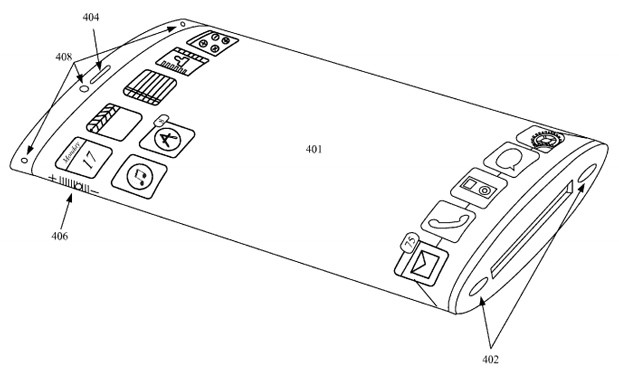
Apple is seeking a patent for an iPhone that has a display that wraps around the edges of the device, expanding the viewable area and eliminating all physical buttons altogether.
This patent application reveals that Apple has been thinking about taking advantage of a new generation of displays, which don't have to necessarily be flat and rigid like today's LCDs.
Their patent filing shows a phone similar to a flattened tube of glass, inside of which a display envelops the chips and circuit board. This allows "functionality to extend to more than one surface of the device." The design also means that the display can take up more of the device's surface area, as there is not frame or bezel surrounding the display.
Another interesting thing to note is that Apple's chief competitor, Samsung, had a similar prototype phone with a a display that bent around the edges at a trade show in January. Does this mean more patent wars are to follow?
This patent application reveals that Apple has been thinking about taking advantage of a new generation of displays, which don't have to necessarily be flat and rigid like today's LCDs.
Their patent filing shows a phone similar to a flattened tube of glass, inside of which a display envelops the chips and circuit board. This allows "functionality to extend to more than one surface of the device." The design also means that the display can take up more of the device's surface area, as there is not frame or bezel surrounding the display.
Another interesting thing to note is that Apple's chief competitor, Samsung, had a similar prototype phone with a a display that bent around the edges at a trade show in January. Does this mean more patent wars are to follow?
Sunday, April 7, 2013
Week 9, Post 1 — Google loses another one—Motorola a bad decision?
An Administrative Law Judge at the United States International Trade Commission has given notice of a preliminary ruling that Microsoft's Xbox gaming console does not infringe Google's (Motorola's) patent on a "capability addressable network and menthod therefor."
The Judge's notice just says that no violation was found.This decision brings a lot of questions in to mind about Google's decision to purchase Motorola Mobility. With every Microsoft-Google patent ruling that comes down, Google's logic for spending $12.5 billion on Motorola comes under scrutiny. Microsoft has already won a U.S import ban over one patent, and three German patent injunctions against Motorola, and is fairly likely to win an even more consequential German injunction against Google Maps based on a preliminary injunction given at a trial earlier in March. In a nutshell, Google's Motorola hasn't won anything except a couple of German H.264 patent rulings that it never got to enforce anyway.
So the way it looks right now, is that Google's decision to buy Motorola might not have been the best one.
The Judge's notice just says that no violation was found.This decision brings a lot of questions in to mind about Google's decision to purchase Motorola Mobility. With every Microsoft-Google patent ruling that comes down, Google's logic for spending $12.5 billion on Motorola comes under scrutiny. Microsoft has already won a U.S import ban over one patent, and three German patent injunctions against Motorola, and is fairly likely to win an even more consequential German injunction against Google Maps based on a preliminary injunction given at a trial earlier in March. In a nutshell, Google's Motorola hasn't won anything except a couple of German H.264 patent rulings that it never got to enforce anyway.
So the way it looks right now, is that Google's decision to buy Motorola might not have been the best one.
Week 8, Post 2 — Google's promise: A PR stunt?
Google has promised not to assert select patents against open source software. Its announcement comes a few years after certain companies made the same promise. In 2005, IBM, Sun Microsystems, Computer Associates, etc. promised not to assert select patents against open source software. They all got some publicity for their announcements, but it was obvious for everyone to see that those pledges had not changed anything.
Now, 8 years later, Google has gone the same way those companies did. It pledged a total of ten patents. By comparison, IBM had pledged 500, and Sun approximately 1600.
Google's pledge is the least generous out of the lot. IBM made available about 1% of the company's patents at the time, and Sun's pledges involved more than 1%. Google owns over 17,000 patents, and has pledged only a small fraction of a percent of their portfolio to open source.
This decision has left quite a few confused. Why should a concept that failed with far larger numbers of patents eight years ago suddenly be the answer, with a far smaller number of patents involved this time around? What do you think?
Now, 8 years later, Google has gone the same way those companies did. It pledged a total of ten patents. By comparison, IBM had pledged 500, and Sun approximately 1600.
Google's pledge is the least generous out of the lot. IBM made available about 1% of the company's patents at the time, and Sun's pledges involved more than 1%. Google owns over 17,000 patents, and has pledged only a small fraction of a percent of their portfolio to open source.
This decision has left quite a few confused. Why should a concept that failed with far larger numbers of patents eight years ago suddenly be the answer, with a far smaller number of patents involved this time around? What do you think?
Week 8, Post 1 — Nokia wins German patent injunction against HTC
Nowadays Nokia is in the news more for their patent troubles than for their products. Nokia recently won a German patent injunction against HTC over power-saving technology . This win might give Nokia enough leverage to sell a patent licence to it's Taiwanese rival unless Qualcomm, which provides bandset chipsets to HTC, can enable its customers to deactivate the patented power-saving technique. Deactivation would mean a shorter battery life, which would make HTC lose its competitive edge in the German market.
Judge Dr. Holger Kircher of the Mannheim Regional Court announced that the panel of judges he presides over found HTC to infringe on "reduction of power consumption in a mobile station." HTC was unable to deny infringement of this patent.
Nokia prevailed on a method claim and on an apparatus claim. With respect to the apparatus claim, it's a straightforward injunction. However, with a method claim, it's only infringed if end users actually use the feature. Therefore, the method claim can be worked around by HTC selling such devices to their customers on condition of them taking a license from Nokia (If Nokia offers a license to them at all).
However, HTC downplays the importance of this technique and claims to have removed it from the devices it is currently selling in Germany, suggesting that the fight will go on for some more time.
Judge Dr. Holger Kircher of the Mannheim Regional Court announced that the panel of judges he presides over found HTC to infringe on "reduction of power consumption in a mobile station." HTC was unable to deny infringement of this patent.
Nokia prevailed on a method claim and on an apparatus claim. With respect to the apparatus claim, it's a straightforward injunction. However, with a method claim, it's only infringed if end users actually use the feature. Therefore, the method claim can be worked around by HTC selling such devices to their customers on condition of them taking a license from Nokia (If Nokia offers a license to them at all).
However, HTC downplays the importance of this technique and claims to have removed it from the devices it is currently selling in Germany, suggesting that the fight will go on for some more time.
Week 7, Post 2 — Android likely infringes Nokia patent
Android's famous tethering feature, which enables users to use mobile phones to act as network routers in order to share their internet connections with portable computers, likely infringes on a Nokia patent.
At the ITC, Nokia just defeated Google and HTC with respect to a proper interpretation of US Patent No. 5,884,190 on a "method for making a data transmission connection from a computer to a mobile communication network for transmission of analog and/or digital signals."
This defeat's consequences are far reaching. It now appears very difficult for Google and HTC to deny infringement at the trial, which is in two months, and if they can't prove this patent invalid based on prior art, which would need to be older than June 1995, then a US ban against HTC's android is reasonably likely.
This feature is an android feature that dozens of device makers, including HTC and Samsung, provide to their customers. However, Nokia came up with this well over a decade before Google presented this feature. Here's a picture from the patent document:
At the ITC, Nokia just defeated Google and HTC with respect to a proper interpretation of US Patent No. 5,884,190 on a "method for making a data transmission connection from a computer to a mobile communication network for transmission of analog and/or digital signals."
This defeat's consequences are far reaching. It now appears very difficult for Google and HTC to deny infringement at the trial, which is in two months, and if they can't prove this patent invalid based on prior art, which would need to be older than June 1995, then a US ban against HTC's android is reasonably likely.
This feature is an android feature that dozens of device makers, including HTC and Samsung, provide to their customers. However, Nokia came up with this well over a decade before Google presented this feature. Here's a picture from the patent document:
Week 7, Post 1 — Slide-to-unlock deemed invalid
One of Apple's most discussed and critically examined patents has been its famous user interface patent, slide-to-unlock. Now, Samsung and Google's Motorola Mobility have just scored a win over this patent. The Bundespatentgericht, Germany's Federal Patent Court, ruled that all claims of EP1964022 on "unlocking a device by performing hand gestures on an unlock image" are invalid as granted.
Apple had a fair warning of this. Apple, Samsung, and Google already knew back in december that the Federal Patent Court would be inclined to invalidate this.
The slide-to-unlock patent isn't nearly as strategic as it is famous. Every user of a smartphone with a touch screen needs to perform this gesture frequently. Apple's rivals have all developed workarounds as this patent only covers some of the unlock mechanisms.
The court held that this patent fails to meet the technicity requirement under European Patent law. Software is not patentable in Europe unless it solves a technical problem using technical means. In Apple's case, it's just a visual representation not deemed to constitute a technical innovation.
This is very different from US patent law, in which case "everything under the Sun made by Man" is patent eligible (provided that it is new and inventive).
Saturday, April 6, 2013
Week 6, Post 2 — Samsung might need to pay more than $1.05 billion
In my previous post about Judge Koh's order striking of $450 million of Apple vs. Samsung's first court ruling of a $1.05 billion, I had mentioned that the new figure might be lower or higher than the previous ruling. It seems that this figure might be higher after all.
Samsung itself has confirmed this in a pleading that the new trial is an opportunity for Apple to win even more than before. One of the top misconceptions resulting from the vacating was that the verdict had been slashed down to $600 million dollars. However, this is false.
Apple had initially claimed over $2.5 billion in damages. Even though the jury supported Apple, its verdict only gave Apple 40% of what the court had allowed it to present as a damages claim. Now
Samsung has confirmed "Apple can seek even more damages on these products in the new trial."
However, it's still hard to predict what the new jury will do, but between the 40% and 100% there's room for a lot of improvements in Apple's favor.
Samsung itself has confirmed this in a pleading that the new trial is an opportunity for Apple to win even more than before. One of the top misconceptions resulting from the vacating was that the verdict had been slashed down to $600 million dollars. However, this is false.
Apple had initially claimed over $2.5 billion in damages. Even though the jury supported Apple, its verdict only gave Apple 40% of what the court had allowed it to present as a damages claim. Now
Samsung has confirmed "Apple can seek even more damages on these products in the new trial."
However, it's still hard to predict what the new jury will do, but between the 40% and 100% there's room for a lot of improvements in Apple's favor.
Week 6, Post 1 — Judge rules second trial needed: Apple vs. Samsung
Judge Lucy Koh, the federal judge presiding over two of the Apple vs. Samsung cases in Northern California, has entered an order striking or vacating of $450,514,650 from a $1.05 billion damages award determined by a jury in August 2012 from Samsung to Apple.
This corresponds to 14 Samsung products that now require a new damages trial. This is due to the fact that the court cannot make adjustments it proclaims necessary for legal reasons—the jury set only one damages figure per product, but over half a dozen different intellectual property rights were found infringed. This in turn resulted in a lack of transparency and clarity as to what portion of a per-product damages figure is attributable to a given intellectual property right.
The second damages trial has not been set yet. The court recommends to hold it only after the appellate proceedings. However, irrespective of the fact of when it's held, the new trial may result in a penalty figure that is higher or lower than the $450 million vacating. There will have to be a new jury for this trial.
The fourteen products being reevaluated are:
Galaxy Prevail, Gem, Indulge, Infuse 4G, Galaxy SII AT&T, Captivate, Continuum, Droid Charge, Epic 4G, Exhibit 4G, Galaxy Tab, Nexus S 4G, Replenish, and Transform.
This corresponds to 14 Samsung products that now require a new damages trial. This is due to the fact that the court cannot make adjustments it proclaims necessary for legal reasons—the jury set only one damages figure per product, but over half a dozen different intellectual property rights were found infringed. This in turn resulted in a lack of transparency and clarity as to what portion of a per-product damages figure is attributable to a given intellectual property right.
The second damages trial has not been set yet. The court recommends to hold it only after the appellate proceedings. However, irrespective of the fact of when it's held, the new trial may result in a penalty figure that is higher or lower than the $450 million vacating. There will have to be a new jury for this trial.
The fourteen products being reevaluated are:
Galaxy Prevail, Gem, Indulge, Infuse 4G, Galaxy SII AT&T, Captivate, Continuum, Droid Charge, Epic 4G, Exhibit 4G, Galaxy Tab, Nexus S 4G, Replenish, and Transform.
Week 5, Post 2 — Samsung's failed assertions
Samsung recently lost a cellular standard-essential patent (SEP) lawsuit against Apple in Japan. The patent-in-suit corresponds to U.S. Patent No. 7,447,516 on a "method and apparatus for data transmission in a mobile telecommunication system supporting enhanced uplink service."
Things look grim for Samsung now. Of the 25 SEP assertions by Samsung against Apple that have come to judgement or been dropped, only three have been successful— two in South Korea, and one in the Netherlands.
Samsung's loss in Japan is it's 22nd SEP assertion that went nowhere. A series of losses against Apple by samsung and other companies brings to the forefront Apple's obvious supremacy in patent battles.
Apple highlighted this fact:
Things look grim for Samsung now. Of the 25 SEP assertions by Samsung against Apple that have come to judgement or been dropped, only three have been successful— two in South Korea, and one in the Netherlands.
Samsung's loss in Japan is it's 22nd SEP assertion that went nowhere. A series of losses against Apple by samsung and other companies brings to the forefront Apple's obvious supremacy in patent battles.
Apple highlighted this fact:
"Apple's experience has shown that declared-essential patent holders often fail to satisfy their burdens of proof on these issues in litigation. For example, MMI has asserted ten declared-essential patents against Apple in the United States and Germany. Nine of those patents have been found invalid or not infringed (or both). Similarly, Samsung has asserted over 20 allegedly essential patents against Apple. To date, Samsung has lost thirteen decisions (either because of non-infringement or invalidity or both) and won only three. In addition, Samsung has dropped eight other declared-essential patents, tacitly recognizing the defects in those patents."
Week 5, Post 1 — Samsung Infringes Apple on Text Selection
Samsung's running out of luck. In a time when smartphone wars are getting more intense and petty, Samsung is being found to have infringed on more aspects of the iPhone.
As per an ITC judge's ruling, Samsung has been found to have infringed upon an Apple Patent regarding a text selection feature on smartphones and tablets.
Back in January, Samsung persuaded ITC to review a preliminary ruling that many of its products had infringed heavily on Apple owned patents. ITC took back the case to review it again, and sent some of it back to ITC Judge Thomas Pender.
Recent rulings and news show that this plan backfired on Samsung. Now the case will be presented before the entire commission to uphold or overturn today's ruling.
A lot depends on this vote for Samsung. If they lose, their products that infringe on this patent might be barred for sale in the United States.
Sunday, February 24, 2013
Week 4, Post 2 — America's chronically excessive IP laws
America's current system of patent protection might be doing more harm then good. This system of patent protection is a "drag on GDP" and is a dead weight on an economy that is about to grow.
More and stronger patents, instead of giving rise to productivity, is doing the opposite— it's stalling productivity and innovation. It is being used to protect incumbent major companies from new competitors. This leads to a sense of monopoly, which in the end, tends to lead to little innovation and even lesser progress in terms of gross domestic product.
In 1983, US issued about 60,000 patents. In 2010, that number climbed to 244,000— a four fold increase. However, R&D spending still stagnates around 2.5% of GDP, and total factor productivity is actually declining.
Innovators, instead of innovating, are worrying about legal issues and patent trolls. This instillation of fear prevents them from working towards building better technologies and innovations.
Intellectual monopoly, while having its benefits, also has a lot of negative effects, that is harming the economy.
Article: http://www.businessweek.com/articles/2013-02-24/how-patent-laws-are-stifling-american-growth
Week 4, Post 1 — Patent Wars hit all time high
Patent wars hit an all time high in 2012, with a record number of applications made for international computing patents.
With smartphones and tablet companies, coming in the news for their patent related misbehaviors, the value of patents has upped in the last year. This was responsible for a 19% rise in patents.
Incidents like the Apple-Samsung Intellectual Property lawsuit, where Samsung had to pay $1bn as charges to Apple for infringement, or the case where Google bought Motorola for $12.5bn, has lead to the values of patents going up, and more awareness and usefulness being seen in the use of patents to protect intellectual property.
Virtually every major company in the consumers electronics market is involved with Intellectual property litigation with at least one of it's main competitors.
Companies are arming themselves with more patents than ever before.
http://www.ft.com/cms/s/0/9e17e868-66fe-11e2-a805-00144feab49a.html#axzz2Lt1m8vXe
Week 3, Post 2 — Facebook sued for "Like" button
Facebook is being sued for its Like button — a concept that Rembrandt Social Media claims belongs to Dutch entrepreneur Joannes Josef Everardus van Der Meer's primitive social networking site called Surfbook. Der Meer is supposed to have patented the Like button in 1998.
Rembrandt Social Media, to whom Der Meer left all his patents after his death, is the one suing Facebook. They claim that Rembrandt's patents represent an important foundation of social media as we know it. They claim that Facebook's success is dependent on Surfbook's concept.
This case highlights the problem in today's world regarding Intellectual Property. Companies tend to sue other companies when they themselves lose their creative juice. Patent wars has become just another way for companies to make money by suing others. Millions of dollars are spent in litigation to do with patent infringement, and companies are now taking advantage of this patent infringement trend that is suddenly rising to make a quick profit.
Article: http://communities.washingtontimes.com/neighborhood/business-living/2013/feb/22/dislike-facebook-sued-patent-infringement/
Rembrandt Social Media, to whom Der Meer left all his patents after his death, is the one suing Facebook. They claim that Rembrandt's patents represent an important foundation of social media as we know it. They claim that Facebook's success is dependent on Surfbook's concept.
This case highlights the problem in today's world regarding Intellectual Property. Companies tend to sue other companies when they themselves lose their creative juice. Patent wars has become just another way for companies to make money by suing others. Millions of dollars are spent in litigation to do with patent infringement, and companies are now taking advantage of this patent infringement trend that is suddenly rising to make a quick profit.
Article: http://communities.washingtontimes.com/neighborhood/business-living/2013/feb/22/dislike-facebook-sued-patent-infringement/
Week 3, Post 1 — Apple loses use over iPhone name.
The patent war has become more of a game. Apple recently lost it's right to use the "iPhone" name in Brazil to Gradiente Electronica's "iphone".
On February 14th, Brazil's Insittute of Industry Property, the country's main patent regulator, ruled that Apple held no exlusive rights to use the iPhone name to market it's mobile phones. If Apple continued to do so, Gradiente can sue Apple.
Gradiente holds trademarks through 2018 for the iphone moniker, after having registered it in 2000. Apple only unveiled the iPhone name in 2007, a full seven years after.
This is a huge blow for apple, as Brazil is one of its biggest markets. It doesn't help the fact that Apple is being sued by firms in China, Japan, and USA.
Apple has had trouble with Cisco, for the same reason when it initially released the iPhone name.
Apple also has had trouple with the iPad moniker, with China's Proview Shenzhen, to whom Apple had to give $60 Million.
Let's see how Apple gets out of this one.
On February 14th, Brazil's Insittute of Industry Property, the country's main patent regulator, ruled that Apple held no exlusive rights to use the iPhone name to market it's mobile phones. If Apple continued to do so, Gradiente can sue Apple.
Gradiente holds trademarks through 2018 for the iphone moniker, after having registered it in 2000. Apple only unveiled the iPhone name in 2007, a full seven years after.
This is a huge blow for apple, as Brazil is one of its biggest markets. It doesn't help the fact that Apple is being sued by firms in China, Japan, and USA.
Apple has had trouble with Cisco, for the same reason when it initially released the iPhone name.
Apple also has had trouple with the iPad moniker, with China's Proview Shenzhen, to whom Apple had to give $60 Million.
Let's see how Apple gets out of this one.
Week 2, Post 2 — Kodak licences patents for cheap
Eastman Kodak Co. was suffering through bankruptcy. The digital imaging giant was close to shutting off, and disappearing. But what came in handy for them was their extensive and useful patents. So, what did they do? They decided to sell and license of its digital imaging patents for net proceeds of $527 million.
This transaction has helped build the momentum for Kodak to emerge out of bankruptcy midyear. There is not just one company/firm that Kodak has licensed its patents to. In fact, the consortium of firms include, Facebook Inc., Amazon.com Inc., Apple Inc., Google Inc. and Samsung Electronics Co.
However, this deal could have got Kodak a lot more money if the circumstances were different, i.e, if Kodak was not facing bankruptcy, licensing its patents would have fetched it more money. In fact, Kodak was said to have hoped for more than $2 Billion for its patents. However, the fact that Kodak was in distress, meant that they would agree to a lesser amount of money. This fact, as happens often, was taken advantage of, and they consortium of firms got a very good deal on Kodak's patents.
Kodak still has the rights to use it's patents, and is emerging out from bankruptcy.
Article: http://www.rbj.net/article.asp?aID=193922
This transaction has helped build the momentum for Kodak to emerge out of bankruptcy midyear. There is not just one company/firm that Kodak has licensed its patents to. In fact, the consortium of firms include, Facebook Inc., Amazon.com Inc., Apple Inc., Google Inc. and Samsung Electronics Co.
However, this deal could have got Kodak a lot more money if the circumstances were different, i.e, if Kodak was not facing bankruptcy, licensing its patents would have fetched it more money. In fact, Kodak was said to have hoped for more than $2 Billion for its patents. However, the fact that Kodak was in distress, meant that they would agree to a lesser amount of money. This fact, as happens often, was taken advantage of, and they consortium of firms got a very good deal on Kodak's patents.
Kodak still has the rights to use it's patents, and is emerging out from bankruptcy.
Article: http://www.rbj.net/article.asp?aID=193922
Sunday, February 10, 2013
Week 2, Post 1 — Apple patents everything.
Apple just got granted their 8,368,654th patent
in the US.
This time it was for integrated touch sensor and solar assembly— a portable device whose screen would be touch sensitive as well as have a solar sensor panel.
In
an era where smart phones are packing more features than ever, a major limiting
factor that's seen is the battery life— and now Apple is trying to fix that.
The patent described the technology as “integrated touch sensor and solar panel configurations that may be used on portable devices, particularly handheld portable devices such as a media player or phone are disclosed. The integrated touch sensor array and solar cell stack-ups may include electrodes that are used both for collecting solar energy and for sensing on a touch sensor array. By integrating both the touch sensors and the solar cell layers into the same stack-up, surface area on the portable device may be conserved. In addition to being used for capacitive sensing, the integrated touch sensor and solar panel configurations may also be used for optical sensing."
Tapping solar energy to power cell phones might be an idea that revolutionizes the phone industry, or is a complete miss. In case solar powered phones do develop, and have a battery life that surpasses all current ones, then the question remains that only Apple will be using this technology, and not any other company.
Thus,
if Apple manages to succeed with the implementation of this new technology, its
features, along with it's unbeatable and now, eco-friendly technology, will
lead to Apple going even further in its race to be the numero uno, with no one
to compete against them.
There have been other solar powered phones in the past, notably, Samsung's Blue Earth phone. However, none of them have been an economic success in the market.
Here's to see if Apple can once again influence the market and create another game changer.
Articles:
http://oilprice.com/Latest-Energy-News/World-News/Apple-Granted-Patent-for-New-Solar-Powered-iPhone.html
http://inhabitat.com/samsung-releases-solar-powered-phone/
Week 1, Post 2 — And I'm taking this class, because...
I'm interested in entrepreneurship, and my goal at college is to touch bases on all aspects of creating and starting your own business.
A huge part of starting your own venture, is to deal with intellectual property. Industrial Engineering and Operations Research 190G will help me gain a better understanding of intellectual property, patents and more.
Using wireless cellular devices as a platform to explore patents, this class shall help acquaint me with the technological aspects of patents. I expect to learn and understand issues arising from patents, patent engineering, patent wars, and more.
This class is a step I want to take to equip myself with the knowledge of protecting intellectual property through patents, and it's uses. This will be useful, especially at a time when intellectual property theft and infringement is rampant.
Moreover, the interesting and unconventional syllabus and style of learning in this class intrigued me in to taking it!
A huge part of starting your own venture, is to deal with intellectual property. Industrial Engineering and Operations Research 190G will help me gain a better understanding of intellectual property, patents and more.
Using wireless cellular devices as a platform to explore patents, this class shall help acquaint me with the technological aspects of patents. I expect to learn and understand issues arising from patents, patent engineering, patent wars, and more.
This class is a step I want to take to equip myself with the knowledge of protecting intellectual property through patents, and it's uses. This will be useful, especially at a time when intellectual property theft and infringement is rampant.
Moreover, the interesting and unconventional syllabus and style of learning in this class intrigued me in to taking it!
Week 1, Post 1 — About Me
Hello, My name is Abhishek! Welcome to my blog!
This blog will outline my work and growth in the class, Industrial Engineering and Operations Research 190G.
Here is a little something about me:
I was born and brought up in Calcutta, India. I first came to the United States of America in Fall '11 as an international student at the University of California, Berkeley. It's been two years, and I love it here!
I intend to major in Business Administration, with minors in Theater (Acting) and Chinese (Mandarin).
I am interested in entrepreneurship, and the classes, clubs, and activities I'm involved in cohesively work to help strengthen and complement my entrepreneurial abilities.
I currently live in a residential incubator, Agora Startup House, and live and work with other budding student entrepreneurs.
I mentor freshmen in areas of social entrepreneurship through this student organization, Compass Fellowship. This is one of my greatest passions as this enables a two way exchange of information, and I learn from my mentees as much, if not more than what I teach them.
I'm also very passionate about theater. I've been acting since I was 5 years old, and I'm still involved in the theater scene at Berkeley. I plan to minor in Acting.
An interesting fact about me is that I plan to finish learning proficiently the 4 most spoken languages in the world before I graduate— Mandarin, Spanish, English, and Hindi.
Subscribe to:
Comments (Atom)