Another silly patent that the American patent system can be criticized for is a Foot pump powered neck massaging device. So, as you walk, your neck gets squeezed every time you take a step. It includes multiple bladders secured to the lower surface of a shoe worn by the user. The first bladder and the second bladder each have an air outlet. A massaging hand is attached to this. It also consists of pliable fingers. The fingers are conformable around the user's neck.
This is an extremely absurd patent, and is not useful at all.
Patents and more
Saturday, May 11, 2013
Friday, May 10, 2013
Week 14, Post 1 — It slices! It dices! It collects evidence!
US Patent No. 7131444 is about an Internal Implement Allotropy Sexual Aid Utensil Universal-Disk. This awkwardly titled patent sets "a new standard for internal personal prevention worn in the female vagina." It is an anti-rape device which is quite admirable in its thoroughness:
This invention is inserted into the vagina of a female wearing it in the same way as a tampon length wise and pushing it into the vaginal cavity. Upon placement in the vagina, the invention blocks the entrance to the vagina, and exposes a resilient hollow receptacle tip covering a sharp circular projectile disk with a dimensional center hole covering the specimen cavity. The sharp projectiles will inflict a sharp non-lethal pain to head of the penis attempting to penetrate the vagina, and the dimensional center hole is designed to collect specimens when the head of the penis makes contact with the sharp circular projectile disk.
This is definitely not a useful invention in terms of practicality. The inventor himself acknowledges about this impracticality. However his defense is that, "Men considering rape, after this invention becomes known, will hopefully not attempt it, with the dread that any women [sic] could be wearing this. Just the idea of it is enough—it doesn't even need to become a product to be effective. So help me spread the word!"
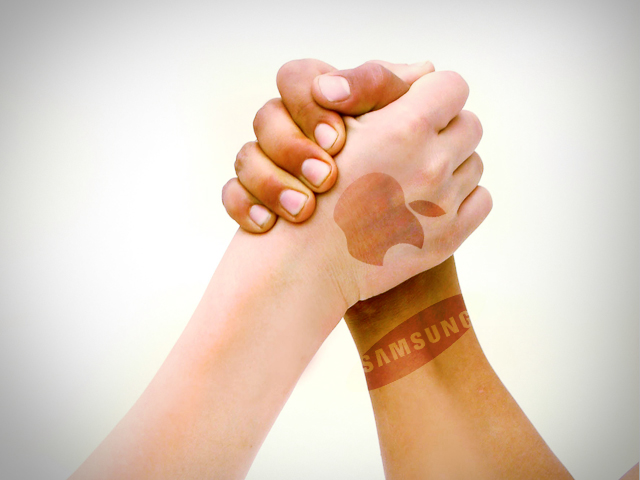
Week 13, Post 2 — Apple and Samsung relations set to improve
As I come towards the end of a very interesting semester, where the majority of articles I've read have been about Apple and Samsung's rocky relationship, with each company suing the other at every opportunity, I want to discuss the possibility of their relationship improving.
Apple's current CEO, Tim Cook has a very different view from Apple's ex-CEO Steve Jobs, who in the past announced thermonuclear war against Google's Android. Cook reportedly never wanted to sue Samsung in the first place over various patents and copyright infringement. He said that he isn't interested in suing Samsung, as the South Korean giant is one of the key component suppliers for the iPhone and iPad.
For Samsung, Apple is being regarded as more than a client. As we all know, the most valuable tech company holds many important patents especially for smartphones and tablets with touch based features.
For future releases such as Samsung Galaxy S4 and the next iPhone, relationship is key.
Only time will tell, whether this relationship will improve or not.
Week 13, Post 1 — Apple granted patent that would disable phone based on location
Apple has been granted a patent that would enable or disable certain features of a phone depending on its location.
The patent, which is called "Apparatus and methods for enforcement of policies upon a wireless device" would use a sensor in the phone to detect whether it was allowed to take pictures or make calls. It relies on GPS, cell tower or Wi-Fi data to determine location, and then "changing one or more functional or operational aspects" of the device.
For example, it would set the phones to silent in a movie theater, prevent outgoing calls in a classroom, turn off wi-fi in a hospital, and many more instances.
However, it raises serious questions about who really owns your device. This system could be abused and used as a useful tool for any oppressive regime.
However, Apple has yet again managed to get more patents, even though there is no idication that it is going to be implemented.
Week 12, Post 2 — Apple granted patent for Invisible Button
Apple most certainly has become the leader in the smartphone world when it comes to owning patents. Very recently, it got granted a patent for something it had been working on since 2006. It was granted a patent for invisible buttons and slider controls.
While the patent was granted on May 7th, it had been filed nearly 5 years back, on October 24th 2008.
The patent says that the buttons would be made of the same material as the device's housing, and set flush to the surface, indicating the buttons would appear as part of the iPhone bezel.
As the patent describes, "“An input device includes a deflection based capacitive sensing input. Deflection of a metal fame of the input device causes a change in capacitance that is used to control a function of an electrical device. The input appears selectively visible because it is made of the same material as the housing it is contained in and because it is selectively backlit through tiny holes.”
A possibility of a backlight exists which would illuminate the invisible button or slider's location when it is needed, and use a sensor to track the user's motion.
While the patent was granted on May 7th, it had been filed nearly 5 years back, on October 24th 2008.
The patent says that the buttons would be made of the same material as the device's housing, and set flush to the surface, indicating the buttons would appear as part of the iPhone bezel.
As the patent describes, "“An input device includes a deflection based capacitive sensing input. Deflection of a metal fame of the input device causes a change in capacitance that is used to control a function of an electrical device. The input appears selectively visible because it is made of the same material as the housing it is contained in and because it is selectively backlit through tiny holes.”
A possibility of a backlight exists which would illuminate the invisible button or slider's location when it is needed, and use a sensor to track the user's motion.
Week 12, Post 1 — EU backs Apple over Google-Motorola patent move
The European Union made a preliminary antitrust finding against Google's mobile communications unit, Motorola Mobility, for seeking and enforcing an injunction against Apple in Germany over patents essential to smartphones and tablets.
The European Union had reached a "preliminary view" on a competition investigation opened in April 2012. It's decided that Motorola Mobility's actions amount to an abuse of a dominant position prohibited by EU anti-trust rules.
The finding is in direct relation to the commission trying to ensure that companies do not use their patent portfolios to block or harm others from using the technologies vital to developing some of the most popular consumer electronics.
As EU competition Commissioner Joaquin Alumnia said, "The protection of intellectual property is a cornerstone of innovation and growth. But so is competition. I think that companies should spend their time innovating and competing on the merits of the products they offer -- not misusing their intellectual property rights to hold up competitors to the detriment of innovation and consumer choice."
This comes at a time when the integrity of patent wars are being questioned again and again. Are companies using patents to arm themselves against competitors, or are they using patents to harm their competitors. This is a very thin line that companies keep crossing, and a line that needs to be established.
The European Union had reached a "preliminary view" on a competition investigation opened in April 2012. It's decided that Motorola Mobility's actions amount to an abuse of a dominant position prohibited by EU anti-trust rules.
The finding is in direct relation to the commission trying to ensure that companies do not use their patent portfolios to block or harm others from using the technologies vital to developing some of the most popular consumer electronics.
As EU competition Commissioner Joaquin Alumnia said, "The protection of intellectual property is a cornerstone of innovation and growth. But so is competition. I think that companies should spend their time innovating and competing on the merits of the products they offer -- not misusing their intellectual property rights to hold up competitors to the detriment of innovation and consumer choice."
This comes at a time when the integrity of patent wars are being questioned again and again. Are companies using patents to arm themselves against competitors, or are they using patents to harm their competitors. This is a very thin line that companies keep crossing, and a line that needs to be established.
Week 11, Post 2 — Samsung files patent for Flexible HDTV
Samsung is not only known for their many smartphone patents, but also the many patents for their other electronic products. One such patent that Samsung has filed is for a flexible television screen. I found this extremely interesting, and shall be discussing this patent, instead of the usual smartphone patents.
Samsung has filed a patent application for a television display unit that users can adjust by remote control to get a better viewing angle. The flexibility of the TV display will be beyond that of the standard HDTV mounted on a stand. The television screen aims to be so flexible that the display can bend in different angles and varying degrees to suit the user's preference. Users can also adjust the images via remote control, so that they would match the bending, and come out distorted.
With the remote control, users can select the angle, the part that is going to be bent, the direction of the bend, and the degree of the bend as well. The controller will have menus and command keys for selecting these data, and will use infrared or bluetooth technology.
This patent was filed a year ago, however, it is still uncertain whether or not they will release this product in to the market.
Samsung has filed a patent application for a television display unit that users can adjust by remote control to get a better viewing angle. The flexibility of the TV display will be beyond that of the standard HDTV mounted on a stand. The television screen aims to be so flexible that the display can bend in different angles and varying degrees to suit the user's preference. Users can also adjust the images via remote control, so that they would match the bending, and come out distorted.
With the remote control, users can select the angle, the part that is going to be bent, the direction of the bend, and the degree of the bend as well. The controller will have menus and command keys for selecting these data, and will use infrared or bluetooth technology.
This patent was filed a year ago, however, it is still uncertain whether or not they will release this product in to the market.
Subscribe to:
Comments (Atom)