Monday, April 8, 2013

Week 10, Post 2 — Apple sued over Siri Patent

Apple's conflicts in China are back. This time, Apple is being sued over the patent to Siri in China. The case does appear to have some foundation, and this could be a worrying case for Apple:


"A Chinese court has heard claims that Apple’s Siri personal assistant infringes a patent owned by a local firm that makes similar voice-activated software for both iOS and Android, in just the latest setback for Cupertino in the country.
Shanghai’s Zhizhen Network Technology Co. first patented its “Xiao i Robot” software in 2004, three years before Siri made her rather troubled (but heavily marketed) entrance into the market. Zinzhen claims more than 100 million users in China for the software, in a wide variety of industries."

When it comes to determining priority, the Chinese patent predates the existence of the iPhone, so there isn't really an issue there. However, the question arises whether Apple is indeed violating this patent.

Now, Apple faces two problems. Firstly, if it loses the patent case, they'll have to stop selling or at least take Siri of those phones that they do sell. They would also have to pay a huge damages fee. Secondly, losing the patent case in China would mean that Siri's patent is not secure anywhere else either, as anyone who would want to challenge Siri's patent could just point to the Chinese patent as prior art.

This case is a more worrying case than what Apple was involved in before in China.

Week 10, Post 1 — Motorola patents Octagon Shaped smartphone

Patents have become ammunition for companies to use against each other. Google and Motorola have recently been approved by the USPTO a patent for an octagonal smartphone. The design is more specific than Apple's rectangle patent, which has been quite the center of attention for many court battles.

However, unlike Apple's patent, Motorola would have an easier time going after companies infringing the more unique octagonal shape they have patented. But the question remains, who would want to go after that shape? It doesn't look too aesthetically pleasing. Would any company even bother to infringe upon the shape? Could this be the shape for devices of the future?

This remains to be seen. Till then, Motorola lays claim to the design.

Week 9, Post 2 — Apple seeks patent for wrap-around display

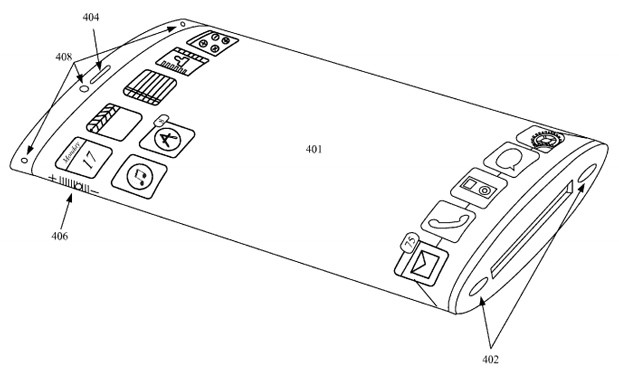
Apple is seeking a patent for an iPhone that has a display that wraps around the edges of the device, expanding the viewable area and eliminating all physical buttons altogether.

This patent application reveals that Apple has been thinking about taking advantage of a new generation of displays, which don't have to necessarily be flat and rigid like today's LCDs.

Their patent filing shows a phone similar to a flattened tube of glass, inside of which a display envelops the chips and circuit board. This allows "functionality to extend to more than one surface of the device." The design also means that the display can take up more of the device's surface area, as there is not frame or bezel surrounding the display.

Another interesting thing to note is that Apple's chief competitor, Samsung, had a similar prototype phone with a a display that bent around the edges at a trade show in January. Does this mean more patent wars are to follow?

Sunday, April 7, 2013

Week 9, Post 1 — Google loses another one—Motorola a bad decision?

An Administrative Law Judge at the United States International Trade Commission has given notice of a preliminary ruling that Microsoft's Xbox gaming console does not infringe Google's (Motorola's) patent on a "capability addressable network and menthod therefor."

The Judge's notice just says that no violation was found.This decision brings a lot of questions in to mind about Google's decision to purchase Motorola Mobility. With every Microsoft-Google patent ruling that comes down, Google's logic for spending $12.5 billion on Motorola comes under scrutiny. Microsoft has already won a U.S import ban over one patent, and three German patent injunctions against Motorola, and is fairly likely to win an even more consequential German injunction against Google Maps based on a preliminary injunction given at a trial earlier in March. In a nutshell, Google's Motorola hasn't won anything except a couple of German H.264 patent rulings that it never got to enforce anyway.

So the way it looks right now, is that Google's decision to buy Motorola might not have been the best one.

Week 8, Post 2 — Google's promise: A PR stunt?

Google has promised not to assert select patents against open source software. Its announcement comes a few years after certain companies made the same promise. In 2005, IBM, Sun Microsystems, Computer Associates, etc. promised not to assert select patents against open source software. They all got some publicity for their announcements, but it was obvious for everyone to see that those pledges had not changed anything.

Now, 8 years later, Google has gone the same way those companies did. It pledged a total of ten patents. By comparison, IBM had pledged 500, and Sun approximately 1600.

Google's pledge is the least generous out of the lot. IBM made available about 1% of the company's patents at the time, and Sun's pledges involved more than 1%. Google owns over 17,000 patents, and has pledged only a small fraction of a percent of their portfolio to open source.

This decision has left quite a few confused. Why should a concept that failed with far larger numbers of patents eight years ago suddenly be the answer, with a far smaller number of patents involved this time around? What do you think?

Week 8, Post 1 — Nokia wins German patent injunction against HTC

Nowadays Nokia is in the news more for their patent troubles than for their products. Nokia recently won a German patent injunction against HTC over power-saving technology . This win might give Nokia enough leverage to sell a patent licence to it's Taiwanese rival unless Qualcomm, which provides bandset chipsets to HTC, can enable its customers to deactivate the patented power-saving technique. Deactivation would mean a shorter battery life, which would make HTC lose its competitive edge in the German market.

Judge Dr. Holger Kircher of the Mannheim Regional Court announced that the panel of judges he presides over found HTC to infringe on "reduction of power consumption in a mobile station." HTC was unable to deny infringement of this patent.

Nokia prevailed on a method claim and on an apparatus claim. With respect to the apparatus claim, it's a straightforward injunction. However, with a method claim, it's only infringed if end users actually use the feature. Therefore, the method claim can be worked around by HTC selling such devices to their customers on condition of them taking a license from Nokia (If Nokia offers a license to them at all).

However, HTC downplays the importance of this technique and claims to have removed it from the devices it is currently selling in Germany, suggesting that the fight will go on for some more time.

Week 7, Post 2 — Android likely infringes Nokia patent

Android's famous tethering feature, which enables users to use mobile phones to act as network routers in order to share their internet connections with portable computers, likely infringes on a Nokia patent.

At the ITC, Nokia just defeated Google and HTC with respect to a  proper interpretation of US Patent No. 5,884,190 on a "method for making a data transmission connection from a computer to a mobile communication network for transmission of analog and/or digital signals."

This defeat's consequences are far reaching. It now appears very difficult for Google and HTC to deny infringement at the trial, which is in two months, and if they can't prove this patent invalid based on prior art, which would need to be older than June 1995, then a US ban against HTC's android is reasonably likely.

This feature is an android feature that dozens of device makers, including HTC and Samsung, provide to their customers. However, Nokia came up with this well over a decade before Google presented this feature. Here's a picture from the patent document:


Week 7, Post 1 — Slide-to-unlock deemed invalid

One of Apple's most discussed and critically examined patents has been its famous user interface patent,  slide-to-unlock. Now, Samsung and Google's Motorola Mobility have just scored a win over this patent. The Bundespatentgericht, Germany's Federal Patent Court, ruled that all claims of EP1964022 on "unlocking a device by performing hand gestures on an unlock image" are invalid as granted.

Apple had a fair warning of this. Apple, Samsung, and Google already knew back in december that the Federal Patent Court would be inclined to invalidate this.

The slide-to-unlock patent isn't nearly as strategic as it is famous. Every user of a smartphone with a touch screen needs to perform this gesture frequently. Apple's rivals have all developed workarounds as this patent only covers some of the unlock mechanisms.

The court held that this patent fails to meet the technicity requirement under European Patent law. Software is not patentable in Europe unless it solves a technical problem using technical means. In Apple's case, it's just a visual representation not deemed to constitute a technical innovation.

This is very different from US patent law, in which case "everything under the Sun made by Man" is patent eligible (provided that it is new and inventive).

Saturday, April 6, 2013

Week 6, Post 2 — Samsung might need to pay more than $1.05 billion

In my previous post about Judge Koh's order striking of $450 million of Apple vs. Samsung's first court ruling of a $1.05 billion, I had mentioned that the new figure might be lower or higher than the previous ruling. It seems that this figure might be higher after all.

Samsung itself has confirmed this in a pleading that the new trial is an opportunity for Apple to win even more than before. One of the top misconceptions resulting from the vacating was that the verdict had been slashed down to $600 million dollars. However, this is false.

Apple had initially claimed over $2.5 billion in damages. Even though the jury supported Apple, its verdict only gave Apple 40% of what the court had allowed it to present as a damages claim. Now
Samsung has confirmed "Apple can seek even more damages on these products in the new trial."

However, it's still hard to predict what the new jury will do, but between the 40% and 100% there's room for a lot of improvements in Apple's favor.

Week 6, Post 1 — Judge rules second trial needed: Apple vs. Samsung

Judge Lucy Koh, the federal judge presiding over two of the Apple vs. Samsung cases in Northern California, has entered an order striking or vacating of $450,514,650 from a $1.05 billion damages award determined by a jury in August 2012 from Samsung to Apple.

This corresponds to 14 Samsung products that now require a new damages trial. This is due to the fact that the court cannot make adjustments it proclaims necessary for legal reasons—the jury set only one damages figure per product, but over half a dozen different intellectual property rights were found infringed. This in turn resulted in a lack of transparency and clarity as to what portion of a per-product damages figure is attributable to a given intellectual property right.

The second damages trial has not been set yet. The court recommends to hold it only after the appellate proceedings. However, irrespective of the fact of when it's held, the new trial may result in a penalty figure that is higher or lower than the $450 million vacating. There will have to be a new jury for this trial.

The fourteen products being reevaluated are:

Galaxy Prevail, Gem, Indulge, Infuse 4G, Galaxy SII AT&T, Captivate, Continuum, Droid Charge, Epic 4G, Exhibit 4G, Galaxy Tab, Nexus S 4G, Replenish, and Transform.

Week 5, Post 2 — Samsung's failed assertions

Samsung recently lost a cellular standard-essential patent (SEP) lawsuit against Apple in Japan. The patent-in-suit corresponds to U.S. Patent No. 7,447,516 on a "method and apparatus for data transmission in a mobile telecommunication system supporting enhanced uplink service."

Things look grim for Samsung now. Of the 25 SEP assertions by Samsung against Apple that have come to judgement or been dropped, only three have been successful— two in South Korea, and one in the Netherlands.

Samsung's loss in Japan is it's 22nd SEP assertion that went nowhere. A series of losses against Apple by samsung and other companies brings to the forefront Apple's obvious supremacy in patent battles.

Apple highlighted this fact:

"Apple's experience has shown that declared-essential patent holders often fail to satisfy their burdens of proof on these issues in litigation. For example, MMI has asserted ten declared-essential patents against Apple in the United States and Germany. Nine of those patents have been found invalid or not infringed (or both). Similarly, Samsung has asserted over 20 allegedly essential patents against Apple. To date, Samsung has lost thirteen decisions (either because of non-infringement or invalidity or both) and won only three. In addition, Samsung has dropped eight other declared-essential patents, tacitly recognizing the defects in those patents."

Week 5, Post 1 — Samsung Infringes Apple on Text Selection

Samsung's running out of luck. In a time when smartphone wars are getting more intense and petty, Samsung is being found to have infringed on more aspects of the iPhone.

As per an ITC judge's ruling, Samsung has been found to have infringed upon an Apple Patent regarding a text selection feature on smartphones and tablets.

Back in January, Samsung persuaded ITC to review a preliminary ruling that many of its products had infringed heavily on Apple owned patents. ITC took back the case to review it again, and sent some of it back to ITC Judge Thomas Pender.

Recent rulings and news show that this plan backfired on Samsung. Now the case will be presented before the entire commission to uphold or overturn today's ruling. 

A lot depends on this vote for Samsung. If they lose, their products that infringe on this patent might be barred for sale in the United States.